Ancient Egyptian Papyrus Proves That The Israelites Were In Egypt As Slaves
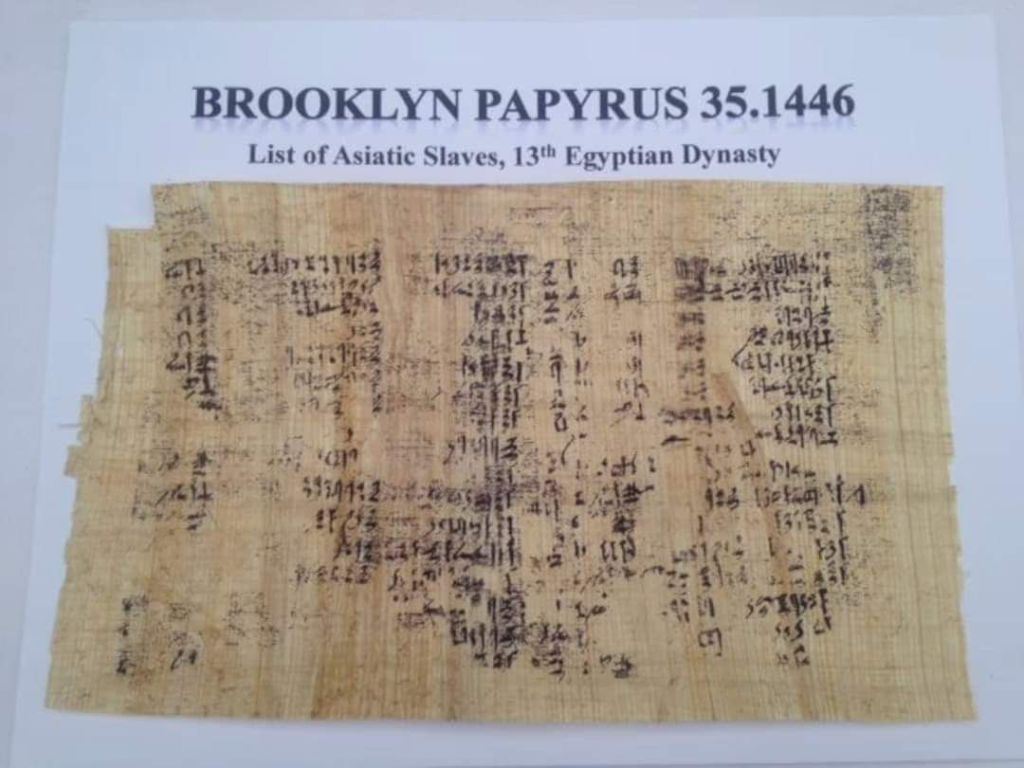
Some skeptics of the Hebrew Bible say there is no real evidence of Israel being in Egypt or as being slaves in Egypt. However this is incorrect. There is a famous papyrus housed in the Brooklyn Museum aptly called the Brooklyn Papyrus or specifically Brookly Papyrus 35.1446. This papyrus was originally purchased by Charles Edwin Wilbur between 1881 and 1896. It was eventually bequeathed to the Brooklyn Museum. It had to be assembled from about 600 fragments. The major published works on this papyrus was by William Hayes in 1955.
The papyrus is a list of slaves that are transferred to a wealthy middle kingdom estate. The papyrus has been securely dated. The first part to Amenhemet III (approx 1830 BCE) and the later part to Sobhotep III about 1743 BCE or the middle of the 13th dynasty Egypt.
The vast majority of the listings of slaves are what the Egyptians referred to as asiatic people coming from Palestine and Syria. What is amazing about this list of slaves in the latter part dated to Sobekhotep III is that the vast majority were female Asiatic with Israelite names.
In the list of slaves on line 11 is written “the female ASiatic, Munahhima (Mnhm) This is a female version of Menahem a Israelite name.
We also find written on line 13 the female Asiatic Sakratu (Sk-r-tw). the Egyptologist William Hayes wrote about this name that this name is “feminine and cannot be separated from the Biblical Hebrew Names Yasahir, Isachar and Sakar”
Also on line 21 we find the female Asiatice Siprah (S-p-r) Hayes writes “Our name is related to=perhaps even ultimately the same as -Aramic Sapphira, “Sappira” and certainly the same (with slight morphological adaptation) as “Shiphrah” name of one of the two Hebrew midwives of Exodus 1:15″
In line 23 is written “The female Asiatic Asra (Is-r)Again Hayes writes “ s-ra (fem) is evidently a feminine hypocoristic oif the same type as masculine Asher, name of one of the twelve tribes of Israel and their ancestor”
There is also the female version of the name for Yakov. One can find even a male slave with the name of David.
Then toward the end of this study of the papyrus (pg 99) William Hayes makes this comment
“Perhaps the most surprising circumstance associated with these Asiatic servants is is that an Upper Egyptian official of the mid Thirteenth Dynasty should have had well over forty of them in his personal possiession. If a comparable number of similar servants was to be found in every large Egyptian household one wonders by what means such quantities of Asiatic serving people found their way into Egypt at this time and how they chanced to be available as domestic servants for private citizens”
Hayes goes on to explain they could not have been war captives because there is no known large campaign into Canaan during the 13th dynasty or before in the middle kingdom. Hayes goes on to speculate that perhaps there was a large slave trade that accounted for these asiatic slaves/servants.
However as the Egyptologist David Rohl writes in his book “Exodus Myth or History” that if we place the Sojourn and the Exodus in the late 12th and 13th dynasty of Egypt then there is a ready explanation of these servants. They are the Israelites who were first welcomed in Egypt and greatly multiplied. Then the Israelites as described in the Hebrew Bible were eventually enslaved by the native Egyptian population. This would account for the vast number of slaves in Egyptian households with Israelite names. this would also account that the majority of slaves/servants are female. As ia written int the story of the book of Exodus Egyptians killed the Israelite boys but kept the girls alive.
The Brooklyn papyrus proves that there the Israelites were in Egypt as slaves in the 13th dynasty. Those who would deny such evidence do so because they place the Israelite sojourn and the Exodus in the wrong time period. However by placing the sojourn and the Exodus in the right time frame then one can find evidence outside of the Bible for Israelites slaves in Egypt.
 Hebrew Messianic Israel