The proper translation of 1 Tim 3:2 requires both the plausibility test and harmonization test followed by the historical context test to be translated numeral “one” wife instead of indefinite “one,” “first” or “a” wife.
The plausibility for numeral one is low because the context presents managing a household as being a prerequisite for service. Having multiple wives like the Patriarchs and Prophets of the OT indicates a man can manage a very large group, improving his potential for Eldership.
The chance of an indefinite “one” or “a” wife is very high, why? “You can’t watch my dog until you have one yourself” means at-least “one” rather than at-most “one” and this sentence structure fits perfectly in the Eldership requirement context.
The chance of ordinal “first” is also plausible because the New Testament concern is divorce and remarriage (eg Matt 5, 19, 1 Cor 7). A sudden concern about polygyny is not only unprecedented but disqualifies men like David, a Prophet, from ministry.
Numeral “one” fails the harmonization test twofold: (1) there’s no other statement in Scripture like it, a total deviation from the Law of God and (2) it suddenly disqualifies the men who wrote the Bible from ministry.
As for the historical context test, Josephus indicates polygyny remains common in the first century. Likewise, although Rome is “monogamy only,” the Romans did practice concubinage. Therefore, some percentage of converts to Christ were plurally married and yet
👉 the New Testament provides NO protocol for the dissolution of plural families NOR prevention of their formation. 👈
In fact, for 1 Cor 7:2 to be fulfilled in congregations where women outnumber men, polygyny would be practiced without any prohibition from the Law (Ex 21:10, Deut 21:15-17).
This is also an important reminder—the early churches did not have a “New Testament” but rather the well established Law of God, and they behaved accordingly. Moral Law (Rom 13:8-10), including Marriage Law, remains in effect in the NT (eg Rom 7:2-3).
“Therefore my judgment is that we should not trouble those of the Gentiles who turn to God, but should write to them to abstain from the things polluted by idols, and from sexual immorality, and from what has been strangled, and from blood. For from ancient generations Moses has had in every city those who proclaim him, for he is read every Sabbath in the synagogues.”
— Acts 15:19-21
All I ask is that you consider the argument on its own merits apart from whoever is making it.
 Hebrew Messianic Israel
So you approve poligamy? direct answer please.
LikeLike
The scripture nowhere prohibits a man taking more than one covenant partner, as many righteous men did and were nowhere rebuked.
LikeLike
Did our forefathers approve of it, and was it regulated in God’s law, and did early Christians practice it according to Roman records, and did Martin Luther the protestant forefather approve of the actions of Prince Philip of Hess who took a second while his first was still alive? Did the practice remain throughout Christendom until the 1500’s council of Trent abolished it by church decree? Answer all of those correctly and you will arrive at the correct conclusion.
LikeLike
Examples of multiple-wife situations in the OT are glaring examples of mayhem, heartache and sorrow. I fail to see how this makes them more qualified. Blessed Abraham, for some unknown reason, felt compelled to send his concubines away. Now, there’s a clue for us. Having checked the Greek “mia” for “one”, this interpretation fulfills the most ancient Law, “They shall be one flesh”, Gen 2:24.
LikeLike
Each covenant union is a “oneflesh” union, in the same manner, as Paul said, a married man may join himself to a harlot and become “oneflesh” with her, that being the act of sexual congress joining spirit and emotions as well. This was roundly rebuked because a man ought to be oneflesh with his covenant partner/s only.
LikeLike
Mayhem, heartache and sorrow ? Have you seen the state of marriages in both Christian and messianic communities? I would describe it as mayhem heartache and sorrow from feminism which has destroyed many marriages. The equalizer is a household wherein a man may have more than one covenant partner to provide power-dynamic balance. If you want a return to strict monogamy, the only way that works outside of a 60 percent divorce rate, is strict patriarchy. I do not see Patriarchy returning before Messiah returns, but Isaiah 3 and 4 (all one passage) tell us polygyny will return.
LikeLike
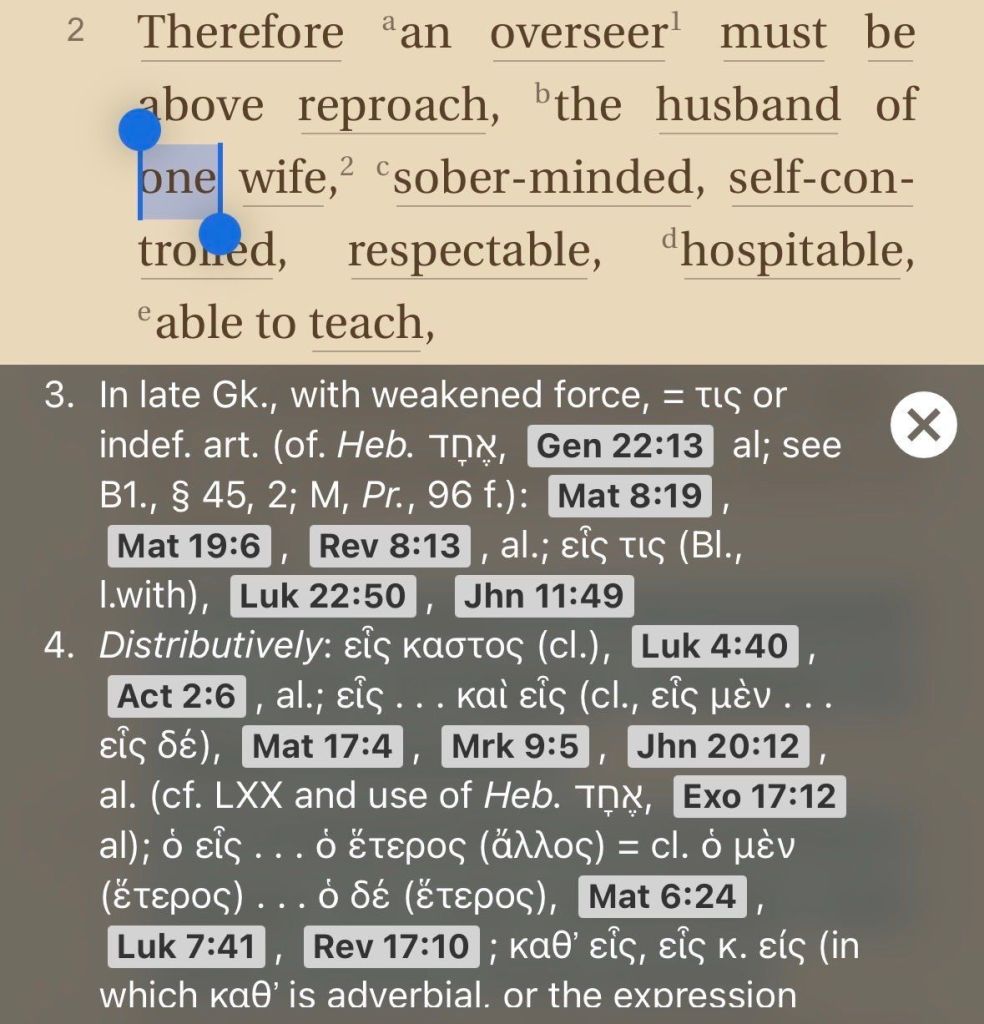
I am surprised to see an unnamed reference cited, operating at the 3rd and 4th entry, rather than the 1st or 2nd. Everywhere I look, this word means “one”. Examples of multiple-wife situations in the OT are glaring examples of mayhem, heartache and sorrow. I fail to see how this makes them more qualified. Blessed Abraham, for some unknown reason, felt compelled to send his concubines away. Now, there’s a clue for us. Having checked the Greek “mia” for “one”, this interpretation fulfills the most ancient Law, “They shall be one flesh”, Gen 2:24.
LikeLike
Abraham sent his sons by the concubines away to the east. Nowhere does it say he sent his concubines away. His sons he gave gifts enough to settle somewhere away from the inheritance of his promised son Isaac.
As for mayhem and such, have you seen the state of marriages in both Christian and messianic communities? I would describe it as mayhem from feminism which has destroyed many marriages. The equalizer is a household wherein a man may have more than one covenant partner to provide power-dynamic balance. If you want a return to strict monogamy, the only way that works outside of a 60 percent divorce rate, is strict patriarchy. I do not see Patriarchy returning before Messiah returns, but Isaiah 3 and 4 (all one passage) tell us polygyny will return.
LikeLike